

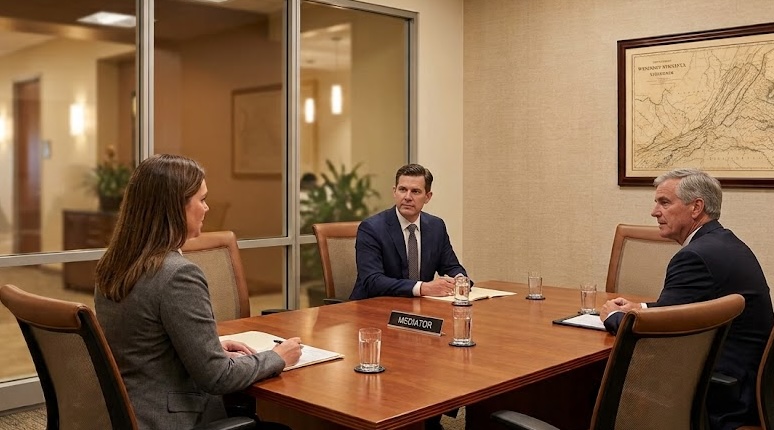
 Most civil cases never reach a jury. They end through negotiated settlements, and a large share of those settlements are reached in mediation. Virginia courts routinely refer parties to mediation, and many contracts require it before a lawsuit can proceed. For someone facing a business dispute, a personal injury claim, or a contested divorce, the process can feel unfamiliar and unpredictable. Knowing how a session is structured, who participates, and what outcomes are realistic makes the day far less intimidating and far more productive.
How Mediation Actually Works
Mediation is a structured settlement negotiation guided by a neutral third party who has no authority to rule on the case. The mediator does not decide who is right, issue findings, or enter a judgment. Instead, the mediator moves between the parties, tests each side’s assumptions, and looks for terms both sides can accept. Sessions usually begin with everyone in one room for brief opening remarks, then split into separate rooms for private discussions called caucuses. Anything said in a caucus stays with the mediator unless a party authorizes it to be shared. That confidentiality is what allows lawyers and clients to talk candidly about weaknesses they would never concede in open court.
Who Attends the Session
The people in the room matter as much as the arguments. Each party attends with counsel, and each side must bring someone with actual authority to settle, which for an insurer or a corporation means a claims representative or officer who can approve a number without calling headquarters. Mediators frequently insist on this requirement because a session stalls the moment a decision maker is unavailable. In personal injury matters, an adjuster typically appears for the defense while the injured party attends in person. In business cases, an owner or executive is usually present alongside outside counsel. Expect the mediator to speak directly to you at some point, not only to your attorney.
Preparing Before The Date
Preparation drives the outcome more than performance on the day itself. Most mediators ask for a confidential position statement in advance summarizing the facts, the legal theories, the damages, and the settlement history. Counsel should assemble the supporting material that makes a number credible, such as medical records, wage documentation, repair estimates, contracts, or accounting records. Clients should walk in with a realistic range rather than a single figure, along with a clear understanding of what happens if the case does not settle. That alternative is worth calculating in detail, including the cost of depositions, expert witnesses, trial preparation, and the delay before a verdict is collected. A party who has priced out trial evaluates offers very differently than one who has not.
Why Parties Choose Mediation
Cost and control are the two most common reasons parties turn to mediation in civil disputes rather than pressing toward trial. A trial date in a contested civil case can be a year or more away, and the expense of expert testimony and discovery often consumes a meaningful portion of what is actually at stake. A verdict is also binary, meaning one side wins the number and the other side does not. Mediation allows for terms a court cannot order, including payment schedules, confidentiality provisions, ongoing business arrangements, mutual releases, and non-disparagement clauses. Privacy matters as well, since trials are public and mediation sessions are not. For businesses and families that expect continued contact after the case ends, a negotiated resolution frequently causes less lasting damage than a public fight.
What Happens During The Day
A typical session runs several hours and sometimes an entire day, with long stretches of waiting between exchanges. Offers move in increments, and early numbers from both sides are usually far apart by design. The mediator will press on the vulnerabilities in your position, which is not hostility but a preview of what opposing counsel would argue to a jury. Frustration around the middle of the day is normal and is not a signal that the process has failed. If the parties reach agreement, the terms are written and signed before anyone leaves, because a handshake without a signed memorandum is difficult to enforce. If no agreement is reached, the case continues on its litigation schedule and nothing said during the session can be used against you.
Making The Process Work For You
Mediation in civil disputes succeeds when both sides arrive prepared, informed, and willing to weigh a certain outcome against an uncertain one. The session is not a test of who argues better, and it does not require conceding that your position is weak. It simply asks whether the value of resolving the matter today exceeds the value of a verdict you may or may not receive months from now. An attorney who knows your case and your priorities can help you answer that question with numbers rather than instinct.
Disclaimer: This article provides general information and is not intended to be legal advice. Legal situations can vary based on specific facts and jurisdiction. For guidance tailored to your circumstances, contact one of our legal experts at the firm.